BITSCOPE product BS300 BITSCOPE MODEL 300

The correct appearance of this website is only visible in graphical browsers that support web standards. We try to ensure our content is accessible to any browser but we recommend you upgrade your web browser if you can.

BS300 BitScopes (BS300S, BS300U and BS300N) have been replaced by the BS310 models.

We support them via BitScope DSO but they are no longer available for sale or as kits.

BitScope 300 MSO

BitScope 300, the affordable MSO !

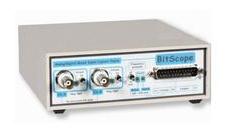
BitScope 300 is our high performance but very affordable Mixed Signal Oscilloscope for use with a PC.

Combining a Digital Storage Oscilloscope, Logic Analyzer, Waveform Generator and Spectrum Analyzer in one robust portable unit, BitScope 300 is the perfect choice for analog, digital or mixed signal environments.
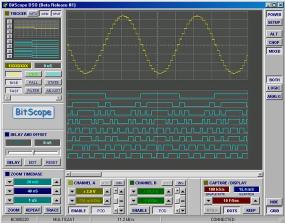
Bitscope

Powerful Software

Included with BitScope 300 is our powerful DSO software that makes maximum use of BitScope's fast and deep mixed mode data capture capabilities.

Whether you're working in analog down at audio frequencies (or below !) or up at the high speeds of microcontrollers and logic in the digital and analog domains, or anywhere in between, BitScope and your PC is the ideal testing and debugging solution.

BitScope is well connected

BitScope 300 is very well connected. Choose from USB, Ethernet (UDP/IP) or RS-232 serial for connection to your PC. You can even have all three if you want !

The power of networking

With BitScope 300 you have the option of networking which offers a huge range of possibilities ! You can connect your BitScope directly to your PC via your Ethernet card, via your LAN to the room next door or via the Internet anywhere around the world.

To see what we mean, try our BitScope 300 from your own PC live via the Internet.

Open Design Hardware

Like the original BitScope published in Circuit Cellar magazine in 1999, the hardware design of BitScope 300 is open and published online and full schematics are available for download. For those who like to build their own kits are also available. Even if you don't plan to build a BitScope this information can be very useful as an aid to understanding how it all works.

User Programmable

Of course if you prefer to write your own DAQ or test instrument software, or maybe plug BitScope into software such as MatLab, LabVIEW, HP VEE or even a standard spreadsheet application, you can ! All BitScopes work pretty much the same way so to make this easy we've published a detailed programming manual providing all the info you need to use it with your own software.

Technical Specifications

Analog Inputs [1] 2 x BNC + 2 x POD
Logic Inputs 8 x POD
Analog Bandwidth [2] 100 MHz
Convertor Bandwidth [3] 75 ~ 100 MHz
Input Impedance 1M/20 pF (standard oscilloscope)
Input Voltage Range (+/-) 262mV ~ 5.52V (x1) & 2.6V ~ 55.2V (x10)
Analog Sensitivity 2mV ~ 50mV
Maximum Sensitivity [4] 300 uV
Fast Sample Rates 4, 5, 10, 13.5, 20, 25, 33, 40 MS/s
Slow Sample Rates [5] 4 kHz ~ 1 MHz (slow) & <1 Hz (burst mode)
Channel Buffer Depth 32 kS x 2 (analog and digital)
Resolution (Convertor) TLC5540 8 bit convertor with 6.8 ~ 7.6 ENOB
Maximum Resolution [6] 11.5 ENOB
Glitch Capture 25 nS
BitScope Digital Trigger 8 bit combinatorial on logic or A/D output.
High Speed Analog Trigger YES
Waveform Generator [7] 10 MS/s (switchable through BNC Channel B)
Analog Interface 2 x BNC and 2 x POD
Logic Interface 1 x DB25 (inc. logic, analog, data and power)
Data Upload Speed (Max) 1.25 Mb/s
Host Interface Options [8] USB, Ethernet, RS-232
Standard PC Software BitScope DSO
Power Requirement 12VDC 500 mA
Operating Temperature 0ºC to 50ºC
Storage Temperature -20°C to +60°C
Size (mm) 150x170x55
[1] Analog capture for both channels is selectable from BNC or POD inputs.
[2] Input bandwidth refers to the bandwidth of the analog input circuitry.
[3] The A/D convertor module bandwidth is 75 MHz. BS300 includes compensation for this convertor to achieve 100 MHz bandwidth throughout.
[4] Specifies minimum viewable voltage with resolution enhancement.
[5] In addition to the fast sample rates, a wide range of "slow clock" and "burst clock" rates are supported (to below 1 Hz). Burst clocking also supports further increased bit resolution (ENOB).
[6] Specifies the maximum effective number of bits (ENOB) achieveable with resolution enhancement enabled.
[7] The waveform generator is now included as standard in all BS300 systems.
[8] Both BNA-01 and BNA-03 can be used with BS300.